
A new study reveals that wood-based BECCS can deliver far fewer climate benefits than often assumed once forest carbon losses, supply-chain emissions, and energy inefficiencies are fully counted.
Bioenergy with carbon capture and storage, or BECCS, is often presented as a win-win technology: it generates energy while removing carbon dioxide from the atmosphere. In earlier mitigation pathways, BECCS was assumed to rely mainly on high-yielding energy crops. But in recent years, interest has grown in using wood from existing forests. In Europe, wood used specifically for energy increased by about 87% from 2000 to 2013 (Joint Research Centre, 2021). In the UK, the Biomass Strategy 2023 explicitly lists wood pellets as a key feedstock for the power sector’s transition to BECCS. The logic sounds simple: trees absorb carbon, wood is burned for energy, and the resulting CO₂ is captured and stored underground. But can wood-based BECCS really deliver its stated purpose of negative emissions? New research suggests that the simple narrative leaves out several critical parts of the carbon balance.
Looking more carefully at the full carbon balance raises several important questions at each step of the process: (1) How much forest carbon is lost when wood is harvested, and how much carbon would the forest have continued storing without harvesting? (2) How much carbon is lost before the fuel even reaches the power plant? And (3) How does wood BECCS compare with natural gas with carbon capture and storage (CCS)?
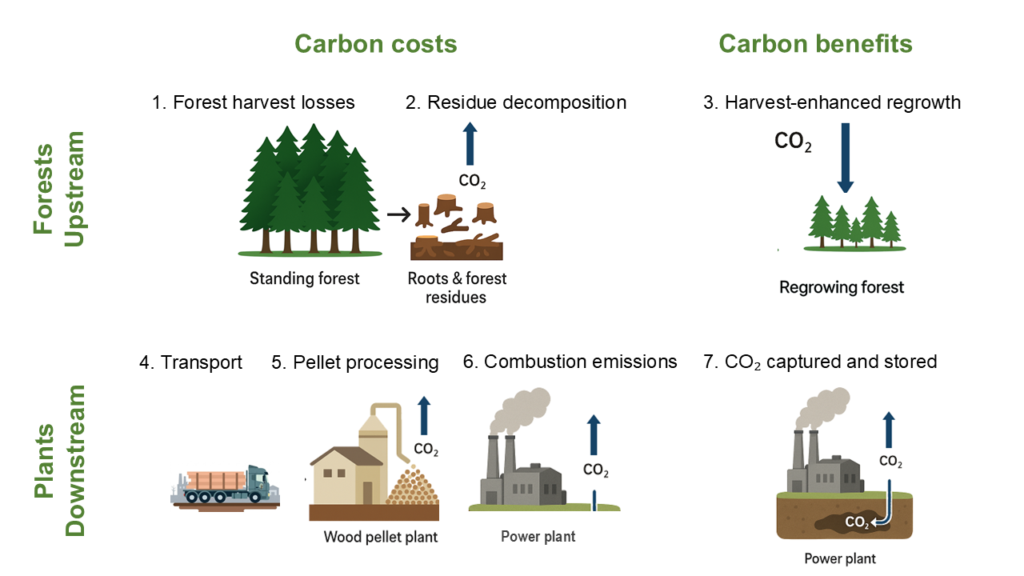
Framework for full carbon accounting of forest-based BECCS
Why woody biomass is not a carbon neutral energy source
The first question is whether wood can really be treated as carbon neutral. Part of the confusion comes from multi-sector greenhouse gas accounting. Under frameworks such as the EU Renewable Energy Directive, emissions from burning biomass are often treated as zero at the point of combustion in the energy sector. But that does not mean the emissions associated with producing and using that biomass are ignored. The reason is to avoid double counting: the carbon loss when biomass is harvested is supposed to be counted in the land-use sector. The problem is that this rule is often misunderstood as proof that bioenergy itself is carbon neutral, when it is really just a rule about where emissions are recorded.
Recognizing that regrowth does not automatically cancel biogenic emissions is the first step. A full accounting needs to estimate the carbon losses that occur in forests when wood is harvested for energy, including carbon released from roots, branches, and other residues, as well as the carbon the forest would have continued storing without harvest. The CHARM model (Peng et al., 2023) is designed to separate the forest carbon effects explicitly attributable to harvests over time. By comparing harvested forests to carbon pools without harvesting activities, it captures both the value of conservation and the continued carbon accumulation of standing forests.
Once forest carbon losses are counted, the next question is what happens after wood leaves the forest. Building on CHARM, the new BECCS-WOOD model tracks carbon from the forest all the way to end use: harvest, regrowth, processing, transport, combustion, and CCS. The final question is whether adding CCS is enough to overcome these disadvantages relative to natural gas. The analysis also compares wood-based BECCS with natural gas systems, with and without CCS, using consistent assumptions about energy conversion and capture. The results show that wood-based BECCS emits more than natural gas with CCS in most scenarios.
The higher emissions relative to natural gas are due to inefficiencies that compound across the whole system.
- Large upstream carbon losses. Before a tonne of carbon in wood reaches a power plant, more than a tonne of carbon emissions may already have occurred in the forest, transportation, and processing chain. Raw wood contains a lot of moisture, so additional emissions occur through drying. More carbon is also lost when raw wood is processed into pellets.
- Inefficient fuel. Wood is already oxygen-rich, meaning it is partly oxidized and contains less chemical energy per unit mass available for release during combustion. Even after drying, wood pellets still contain around 10–15% moisture, so some extra energy is used simply to evaporate that moisture.
- Inefficient fuel energy-electricity conversion. Solid biomass is usually burned in boiler-steam systems, while natural gas can be used in gas turbines and combined-cycle plants that convert fuel to electricity more efficiently.
- More CO₂ to capture, more energy CCS required. CCS can reduce emissions from the power plant, but it also uses energy to separate, compress, and store CO₂. Because wood produces more CO₂ per kWh than natural gas, a wood BECCS plant must process more carbon to deliver the same electricity output. That extra energy use further reduces the net climate benefit.
What if BECCS uses mostly residues from plantations?
An obvious response is that BECCS should work better if it uses more forest residues instead of additional roundwood. That would improve the carbon balance, so the research tested an optimistic scenario in which residues supply 50% of the wood from the intensively managed loblolly plantations. However, even then, 80% of the CO₂ captured by CCS is needed just to offset positive emissions elsewhere in the system, leaving only a small share as a true net negative emission. So residues help, but they do not turn forest-based BECCS into the kind of fast, large-scale negative-emissions solution it is claimed to be.
That also raises a practical question: how far can residue use really be scaled up? In practice, forest residues are harder to collect and require more energy for transport and processing. Removing too much can conflict with other ecological needs, including nutrient cycling, biodiversity, and other ecosystem functions. Even if all potential forest harvest residues in the United States and Europe were used for BECCS, they would still provide only a very small share of current electricity demand. Existing fast-growing plantations also do not solve the problem, because most of that wood is already being used, or expected to be used, for other products. Diverting more plantation wood to BECCS would likely mean taking wood away from those uses or increasing harvest pressure elsewhere.
This research offers a more careful way to think about wood-based BECCS, beyond the hype that often surrounds it. BECCS do capture carbon, but the key question is whether wood from existing forests delivers meaningful net climate benefits once emissions and regrowth are counted across the full system and over policy-relevant timeframes. The results suggest that this is far more difficult than many public discussions imply.
Links for full articles:
New research on BECCS (Searchinger et al. 2026):
https://www.nature.com/articles/s41893-026-01817-8
CHARM global analysis (Peng et al. 2023):